Max Littman, LCSW
February 4, 2026
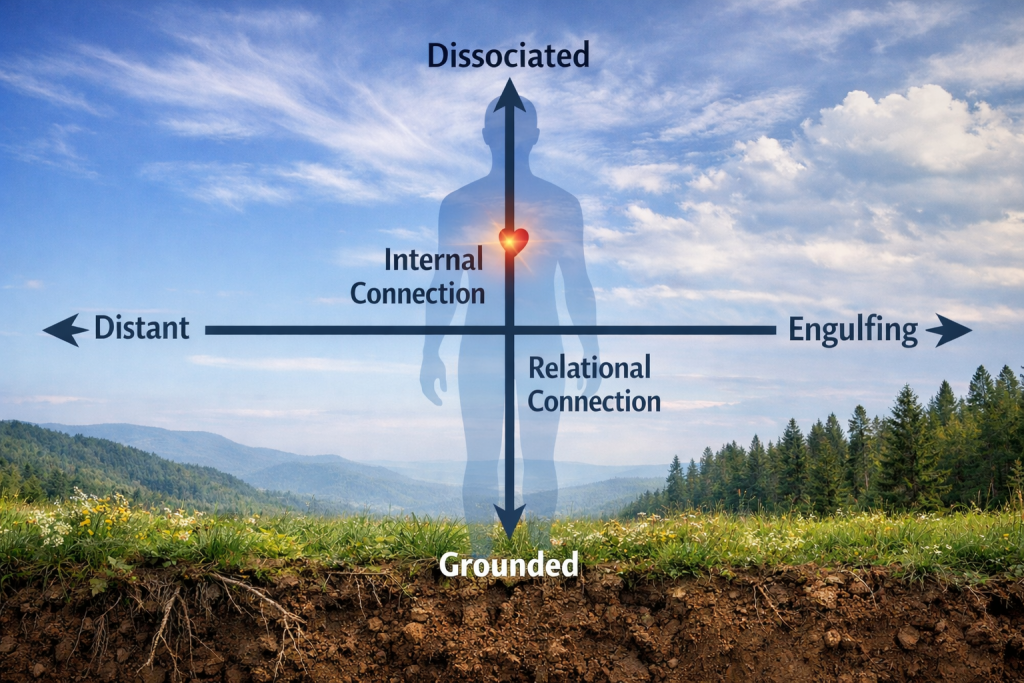
In the therapy room, I often find myself tracking two planes of energy, whether or not I name them out loud. One is internal, a vertical line of connection within the person. The Y axis. The other is relational, a horizontal line between us. The X axis. Directing my attention to these planes, or axes, influences how I listen, how I speak, and how I understand what is happening beneath the words of a session.
I pay attention to how internally present the person feels in the moment, where their energy seems to be along the vertical axis of connection.
I also notice how present they feel with me, where their energy appears along the horizontal axis between us.
Just as importantly, I pay attention to where my energy is along my own vertical and horizontal axes.
Susan McConnell and her model Somatic IFS have given language to this way of sensing, through what she describes as vertical and horizontal access. I experience this less as a strategy to apply absolutely and more as a way I can choose to listen with my whole body. It offers a felt map for discerning connection rather than a technique for producing or forcing it into being.
The vertical axis corresponds with internal connection.
When energy, or attention, is higher on the vertical axis, there is often a sense of distance from the body, from sensation, from emotional immediacy. Sometimes this shows up as dissociation, sometimes as abstraction, sometimes as wordiness or intellectual understanding without presence. Lower on the vertical axis, there is more gravity. More weight in the body. More contact with sensation, impulse, and affect. In theory, lower means more grounded and connected. In practice, it is not always that simple. I have learned to be careful not to romanticize “low” as inherently more connected, better, or more desirable. I have seen forms of stubbornness, collapse, and immobility that are protective, ingenious, even heroic, and that live very low in the body.
The horizontal axis corresponds with relational connection.
Are we feeling far apart? Is there a sense of drifting further or being pushed away as we talk? Sometimes that distance feels defended, a protector moving the system away from contact or maintaining distance. Other times the distance feels lonely rather than defended. There are also moments where the client feels squarely in the relational field with me, neither distant nor fused. And there are moments of closeness that tip toward impingement, where the system comes very near and my own system reacts accordingly to that feeling of engulfment.
What has surprised me is how much these two axes affect each other. When a client moves high vertically and far horizontally, my own system often follows. I notice myself thinking more, feeling less, becoming disconnected to my body. When a client drops lower vertically but presses close horizontally, I may feel a subtle bracing, a tightening in my chest or shoulders.
What continues to stand out to me is how often internal and external connection seem to be the conditions under which the psyche’s regenerative capacity expands or contracts.
When there is enough connection within a person, and enough connection between us, something generates on its own. Wounds that formed in isolation or rupture start to ease. Polarized parts that have been locked in opposition for years sometimes soften their grip without being argued with. I have come to assume that, regardless of which part initiated therapy or what story brought someone into the room, some version of internal rupture or disconnection is present. Connection does not resolve everything in the external world, but it appears to create the conditions in which internal and external repair becomes possible without force, urgency, control, or instruction.
Over time, I have found it useful, and often relieving, to name what I am sensing in regard to the two axes rather than hold it privately. When I name it, I do so as an offering, with consent, and with an open curiosity about the client’s response. This is less about being right and more about seeing what happens when the experience is spoken aloud.
There are moments when naming it brings more connection on both axes. There are moments when it brings less, which is also helpful information. Either way, it is a step toward clarity.
In a recent session, a client was speaking at length, telling a detailed story about events from his week. The content was coherent and engaging, but something felt oddly absent. His words moved quickly, but my sense of him did not move with them. I noticed that internally he felt high on the vertical axis, as if the story were floating above his body rather than emerging from it. Horizontally, I felt we were far apart from each other. I found myself listening carefully but feeling less and less connected.
As he continued, I became aware of something else: a yearning in me to feel more connected. Not urgency, not anxiety. More a gentle pull toward him. A wish to feel closer, which surprised me with its tenderness. I noticed that this yearning felt like care rather than need.
I paused him and said something like this:
“As you’re talking, I’m noticing that I feel a bit far away from you. It’s like your words are here, but you feel somewhere else. And I also notice that I feel myself wanting to feel closer to you, because I care about you. I’m not sure if that fits for you, but I wanted to check.”
He went still. After a moment, he said it felt accurate, and clarifying. He described a shift inside, as if something had landed and come into focus. As he spoke, he noticed a pleasant buzzing sensation in his body, especially in his chest and arms. He said it felt like a rush of energy and connectedness, both to himself and to me, as though something in him had been reached without being pulled on or explained away.
What struck me afterward was not just the shift in him, but the shift in myself and the field between us. He dropped lower vertically, with more sensation and presence. Horizontally, we felt closer, but not crowding each other.
I have also had moments where naming my sense of distance or closeness led to more withdrawal, more defensiveness, or more confusion. In those moments, the response itself told us something important about what was needed or not yet safe to feel into. In such moments, I listen for parts of me that are attached to my client’s energy and attention being in different locations along the axes than they are.
What I appreciate about this way of orienting is that it invites ongoing assessment without turning it into a task. It keeps me curious about how much Self energy, specifically the quality of connectedness, is available in the client and in me, moment by moment, and how that availability changes when the vertical and horizontal experiences are named.
It also reminds me that connection is not a single dimension. Someone can be deeply in their body and far from me. Someone can be emotionally expressive and yet high and disembodied. Someone can feel close but protected, grounded but guarded. The vertical and horizontal axes give me a way to feel into these nuances without forcing them into categories or to change.
Most of all, this orientation keeps the work relational and alive. It asks not, “What should happen next?” but “What is happening now, between us and within us?” And sometimes, simply being aware of, naming, or living inside of that question, gently and honestly, is enough to bring the system into a little more contact with itself, with another human being, and with the powers that Self has to offer.
For feedback and comments, I can be reached at max@maxlittman.com.
I provide consultation and therapy for therapists.
Purchase my new book IFS Therapy for Gay and Queer Men here.