Max Littman, LCSW
March 14, 2026
In this season of life, as a new parent whose attention and energy are more centered on my growing immediate family and as an established therapist in private practice, I have been noticing a difference between two kinds of connection that are often assumed to be more tightly linked than they actually are: fondness and bonding.
Fondness embodies warmth, liking, appreciation, ease, and humor. There is enjoyment of the other person. You are glad when you see them. You might admire them, respect them, or simply feel good in their presence. Fondness can make time together pleasant and light. It can create a sense of warmth and goodwill between people even when their lives are not deeply intertwined. I find many people I am fond of: a colleague at a workshop, a peer at a fitness class, a parent at daycare.
Bonding tends to involve a deeper weaving of lives. It usually forms through shared experience over time: reliance, vulnerability, conflict, repair, mutual influence, and the gradual accumulation of history between people. When a bond forms, the wellbeing of one person begins to matter to the other in a way that reorganizes how the relationship functions. There is more at stake. The relationship carries weight. The bonds beyond my parents, who frequently come to bond with our new daughter, are beginning to take a back seat.
Fondness may develop into bonding, and fondness may certainly be present within a bond. Yet being fond of someone we are bonded with is not always the primary factor in that bond, at least in my experience. Some of the strongest bonds in my life have formed not primarily because we liked each other so much at the beginning, but because we lived through things together, relied on each other, and gradually became woven into each other’s lives, sometimes intentionally and sometimes circumstantially.
Fondness, on the other hand, often allows warmth without that level of relational entanglement. It carries less emotional, relational, and social risk. It can exist easily within larger social circles and newer relationships. It makes community possible without requiring the kind of emotional and practical investment that bonding tends to involve.
Noticing the connections and differences between fond and bond has helped me understand something about the relationships in my life right now.
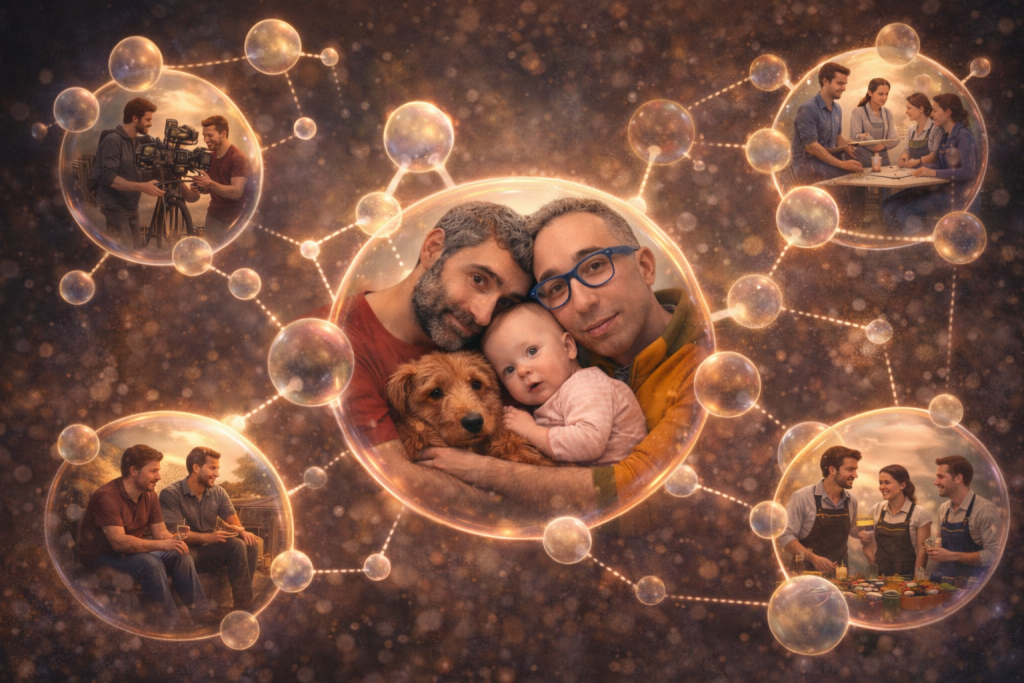
I feel deeply bonded to my husband. Our lives are intertwined in ways that touch nearly every aspect of daily living. We have moved through years together that include love, conflict, decisions, grief, joy, and the ordinary rhythms of shared life. The bond formed through thousands of small and large moments of being in this physical reality together, while also creating and sharing relational, spiritual, and mental worlds.
The same is true with my daughter. The bond there is primal and immediate. It is built through caregiving, protection, wonder, exhaustion, responsibility, primarily non-verbal communication, and love that feels both biological and existential at the same time.
And then there is our dog, Lucy. Anyone who has had a dog they are deeply attached to knows that the bond there can be just as potent as a bond with another human. It forms through daily rituals: walks, feeding, comfort, licks to the face, pets, playing, and the strange, wordless communication that develops between us. Over time, the bond becomes obvious in how much Lucy’s presence organizes our day and how much her wellbeing matters to us. Bonding with Lucy helped us grieve our previous dog Fozzy and it helped her heal from the trauma of a previously abusive home.
These bonds shape my life in obvious ways.
When I think about friendships, I realize I have experienced both sides of the fondness versus bonding dynamic across different seasons of life.
There were friendships in the past that became deeply bonded. Many of those bonds formed in environments where people were thrown together repeatedly in shared circumstances. Work environments were a major source of this for me. When people are “in the trenches” together, bonds tend to form almost naturally.
I remember working at Trader Joe’s in my twenties, where the work itself was not necessarily intense, but the shared time, tasks, focus, and repetition created camaraderie. Long shifts stocking shelves, dealing with customers, joking around during slow moments, and showing off music tastes through playlists played on the speakers after hours. Over time you start to know people’s lives: their frustrations, personalities, tastes, aspirations, and heartbreaks. You see them tired, annoyed, joyful, and stressed. The repetition of proximity creates familiarity, and familiarity can become bonding.
Later in life, the same thing happened in much more intense environments.
Working in mental health crisis clinics brings a particular kind of closeness between colleagues. The stakes are higher. We were supporting clients through some of the most painful and destabilizing moments of their lives, and at times lives were literally at risk. Staff relied on each other for emotional regulation, consultation, humor, and survival in the middle of difficult shifts. When we sat together after a long day informally processing what had just happened in the clinic, we were bonding. We witnessed things together and acted together in ways that many other people have not.
Those kinds of environments often accelerate relational bonding because people are sharing pressure, responsibility, and emotional exposure.
Some of those friendships have endured over time. Others faded as life moved on. But the bonds that formed in those environments were unmistakable while they were happening.
This current season of life feels different.
My deepest bonds right now are centered around family life. My husband, my daughter, and our dog Lucy sit at the center of that emotional orbit. Parenting, partnership, and caring for a household organize the structure of my days in ways that leave less room for the kind of shared trenches that once created friendship bonds. I am also now in solo private practice. I consult and connect regularly with peers, but it is not the same as being part of a team like it was in the mental health crisis clinics, where a shared purpose and high intensity often lasted twelve hours straight.
There is another subtle shift happening as well. Many social spaces in the gay community have historically organized around freedom from domestic structure: travel, nightlife, spontaneity, sexual exploration, and lives that are not centered around children. Those spaces hold real value and meaning for many people. Sometimes this orientation is intentional. At other times it functions more like a cultural undertow that many of us float along with, often without noticing.
At the same time, as our life has become organized around parenting and family rhythms, there has been a quiet sense of distance from parts of the gay community. Increasingly, we find ourselves investing in relationships with other gay dads and with heterosexual parents and their kids whose lives are structured around similar responsibilities and routines. Shared structure tends to create shared trenches, and shared trenches are often where bonds form.
At the same time, I still meet new people and form new relationships.
What I notice, though, is that many of these newer friendships seem to live more in the realm of fondness than bonding. There is genuine warmth. Mutual appreciation. Enjoyable conversations. Respect for each other’s work, humor, personality, or perspective. When we see each other, there is real pleasure in reconnecting.
But the relationship is not necessarily moving toward deeper bonding.
Part of that may simply be life structure. Adults with families, careers, and full schedules often have fewer opportunities for the repeated, open-ended time that bonding tends to require. Without shared trenches or prolonged proximity, relationships may remain lighter by default.
Another part may involve my own internal protection, parts of me who are simply more cautious with emotional investment as life becomes more complex and time constrained.
Some of it may also reflect a natural developmental shift. As I am beginning to recognize more and more, in certain seasons of life we build new bonds constantly. In other seasons, existing bonds deepen while newer relationships remain more in the realm of fondness.
Fondness can still be meaningful. These relationships bring companionship, intellectual stimulation, humor, and sometimes a sense of community. They enrich life in ways that are impactful, even if they do not become deeply bonded friendships.
Yet still, at times I notice a part of me wondering whether something is missing when a relationship stays in the fondness category. Memories surface of earlier phases of life when bonding with friends felt easier and more organic. At age four, a new neighbor introduces himself. A collaboration with a classmate on a filmmaking project in a high school class. Playing video games with a new friend down the hall during freshman year in the university dorms. Going to a full day music festival with a friend from work at Trader Joe’s. Laughing in relief with my “work husband” at the end of a twelve hour shift at the psychiatric crisis clinic. These memories bring a wondering about whether the distance, the lack of movement from fondness to bonding, is circumstantial, protective, or simply the shape of this moment in time.
Other parts of me feel appreciation for what is here without needing every connection to become deeply bonded.
A part reminds me that human social life always contains layers: a few deeply bonded relationships, a wider circle of fond connections, and an even larger set of acquaintances who occupy the edges of my relational world. Recognizing those layers sometimes helps bring clarity and ease.
I can recognize that not every fond connection needs to become a bond. Not every bond needs to remain permanent.
Some people walk beside us through the trenches and become deeply woven into our lives. Others share moments of warmth, appreciation, and mutual respect that remain lighter but still meaningful.
There is another kind of bond I experience, and I imagine many others do as well, that deserves naming, especially because it is rarely spoken about openly: the bond that can form between therapist and client. As a therapist in a solo private practice, this bond is especially apparent and important to me.
No, we as therapists are not friends with our clients. The relationship is structured, boundaried, and ethically defined. Friendships are reciprocal and involve informal expectations of caring for one another in some way, shape, or form. The relational contract in therapy is not reciprocal; it is intentionally weighted toward the client. As therapists, we are responsible for holding the frame, attending to power dynamics, and caring for our own internal systems so that our client’s needs and experiences remain centered. Models like Internal Family Systems, my primary practice model, along with ethical guidelines across the mental health professions, emphasize exactly this: therapists must be responsible for their parts, their reactions, and the way they use themselves in the room.
All of that is true. And still, even when those boundaries are respected and adhered to, a bond forms between therapist and client. In the most effective and transformative therapies, it certainly does.
Over time, therapy often becomes one of the most relationally intimate spaces in a person’s life. Clients share fears, grief, shame, hopes, memories, and longings that may never be spoken anywhere else. Therapists witness these disclosures not once, but week after week, sometimes over years. The work involves emotional presence, attunement, rupture, repair, curiosity, and care. It is difficult for that kind of sustained relational contact not to generate some form of bond.
Yet in many professional spaces we are trained to downplay or dismiss this reality. If the bond is acknowledged at all, it is often quickly reframed in technical language: attachment dynamics, transference, therapeutic alliance, corrective emotional experience. For those of us who interface with insurance panels, this dynamic can become even more pronounced. We are required to document the work in cold clinical language that at best flattens the experience and at worst dehumanizes it.
Ethical frameworks are valuable and necessary, but they can sometimes function as ways of keeping a certain emotional distance from something that is deeply human.
The truth is that therapy can be relationally rewarding for therapists as well. I know this is true for me. There can be moments of connection that feel meaningful, moving, even spiritually significant. Witnessing someone unburden pain they have carried for decades can be profoundly affecting personally, not just professionally. Sitting with someone through grief, fear, or transformation can create a kind of bond that, while not a friendship, still touches something deeply human between the two of us.
There is even a subtle physical dimension to this. I do not mean in the sense of touch or boundary crossing, but in the nervous system. Two bodies sitting across from each other, in person or virtually, regulating together, breathing, feeling, attuning. Over time, the nervous systems of therapist and client learn each other’s rhythms in ways that are tangible even if they are rarely spoken about directly.
For many therapists, parts of us emerge that want to minimize or criticize the importance of this bond. These parts may worry about ethical slippage, overidentification, a client’s dependency on us (or vice versa), or the profession’s long history of boundary violations. Protection that monitors the boundaries of the therapeutic relationship do serve an important function.
But sometimes those parts of us can make it harder to acknowledge how bidirectionally meaningful the work itself can be.
Therapy relationships are not friendships and are not meant to become them. Yet within their boundaries, they can still involve a form of human bonding that is deeply relational, personally moving, and at times spiritually nourishing for both people involved. A deepened respect for the relational power that exists within this bond is likely called for.
So where does this leave me now, one small representation of the human, spouse, parent, adult, gay, and therapist experience in 2026? Parts of me long for more bonds, while others suggest that fondness may be what this stage of life offers most readily, given the time and place I occupy historically and physically. Settle for mutual fondness, they say. Yet denying or ignoring the yearning for deeper bonding does not satisfy the need or make it disappear.
For now, the longing remains alongside the fondness that does exist, both quietly shaping how I understand connection in this season of life.
For feedback and comments, I can be reached at max@maxlittman.com.
I provide consultation and therapy for therapists.
Purchase my new book IFS Therapy for Gay and Queer Men here.