
Max Littman, LCSW
July 15, 2026
Clients sometimes begin a session by saying they do not know where to start.
There may be several things happening at once: a conflict with a partner, a memory that surfaced during the week, a familiar heaviness in the chest, an inexplicable wave of shame, a work situation that seems minor but will not leave them alone. They may worry that choosing one means neglecting the others. At the beginning of therapy, the question can feel even larger. Should we start with childhood? The current relationship? The panic attacks? The body? The overanalysis?
I usually do not experience these as entirely separate roads.
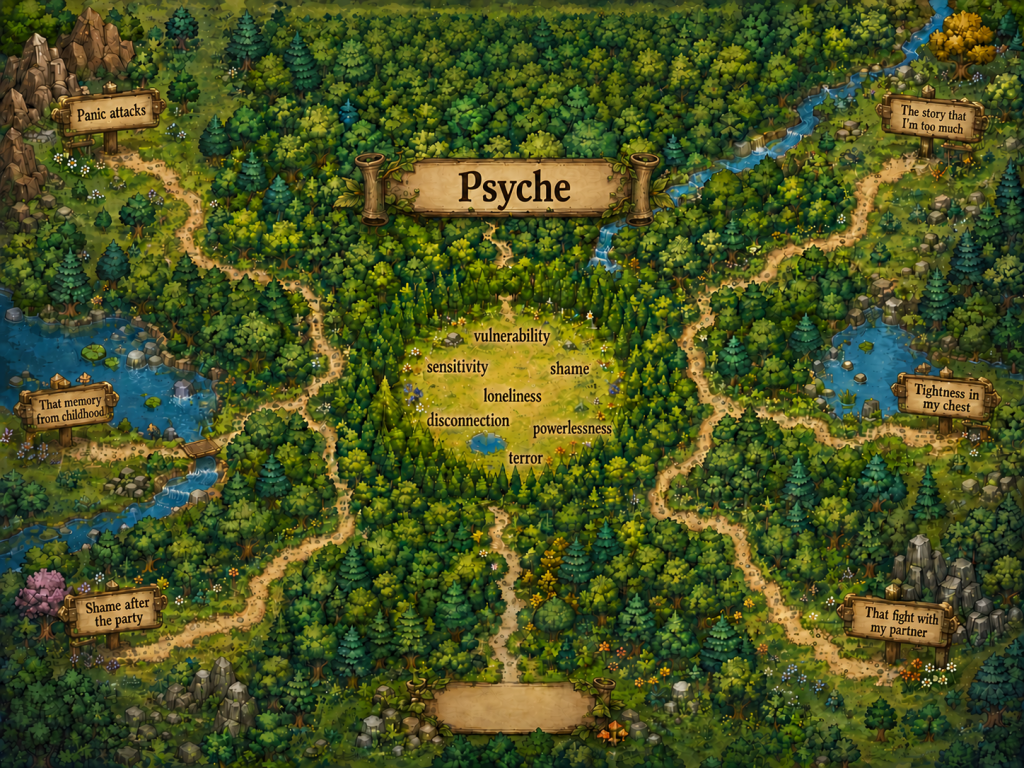
I imagine the psyche as a forest with many possible trailheads. We may enter through a symptom, an emotion, a story, a memory, a belief, a relationship, an image, or a sensation in the body. The trails may initially appear to be heading in very different directions. Some are well marked and familiar. Others are overgrown, steep, or carefully concealed. Yet they belong to the same forest.
Different trailheads, same psyche.
The Anxiety About Choosing Correctly
The concern about where to begin is often more than a practical question. A client may feel pressured to use therapy correctly, to avoid wasting time, or to identify the most important issue before speaking or even showing up that day to therapy.
A client may feel responsible for organizing their inner world into a coherent agenda before the session begins. They may believe they need to present the therapist with the right material in the right order. Some have learned that their feelings will only be taken seriously if they can explain them clearly. Others fear becoming overwhelmed if they tend to too vulnerable territory. Some worry that focusing on what is most present will seem petty or a distraction when there are older or more obviously traumatic experiences they believe they should be addressing.
This can turn the opening of a session into another performance.
Behind the “should” of starting in a particular place, there may be fear of making a mistake, trying to maintain control, or concern that there will not be enough time and space for everything.
The pressure to find the correct trailhead is already one possible trailhead. And often times, when listening closely, it is the first trailhead presented.
Sometimes the most useful response is simply to notice what feels most alive, most available, or most insistent in that moment. We do not need to know where the trail ultimately leads before taking the first few steps. And we can say this explicitly to our clients.
Symptoms as Entry Points
A symptom can look like an isolated problem that needs to be remedied: insomnia, procrastination, emotional numbness, panic, compulsive thinking, jealousy, irritability, or difficulty making decisions. These symptoms connect to underlying vulnerability.
We may begin with the tension in someone’s shoulders when they talk about an upcoming meeting. As we stay with it, the tension may carry a fear of being exposed as inadequate. That fear may connect to a critical parent, an experience of humiliation at school, or a long-standing effort to remain useful enough to belong. A trail that began in the body may eventually open into memory, attachment, identity, or grief.
We could also enter through the story of the meeting itself. We might begin with the client’s anger toward a coworker, the belief that they are being treated unfairly, or the part rehearsing every possible response. These entrances may lead us toward the same underlying territory.
The symptom, story, sensation, and memory are not necessarily competing explanations. They may be different expressions of the same intra-psychic region.
This is one reason I am cautious about assuming that we must first identify the deepest or oldest wound, aside from the fact that in IFS we know we need to earn the trust of the protective system before proceeding to vulnerable territory. What appears closest to the surface may already contain a pathway inward. The outer edges of the forest are still the forest.
The Trails Do Not Always Run Straight
Therapy rarely proceeds in a direct line from presenting problem to core vulnerability.
A trail may circle back. It may split unexpectedly. The client’s protective system may steer us toward a safer route or block the path altogether. We may begin with grief and find anger. We may begin with anger and encounter terror. We may begin with a childhood memory and discover that the most important experience is occurring in the relationship between client and therapist in the present moment.
At times, what looks like a detour is the psyche establishing enough safety to continue.
A client may want to address a painful relationship but spend several sessions talking about work. From the outside, this can appear avoidant or unfocused. Yet the work material may reveal the same fear of disappointing others, the same inability to sense personal limits, or the same expectation that asserting a need will endanger connection. The system may be approaching familiar vulnerability through terrain that feels more metabolizable.
This does not mean every subject automatically leads somewhere profound. Therapy can wander, become overly intellectual, or remain at a distance from experience. Still, movement toward the center cannot always be measured by how directly the most painful material is being discussed.
Sometimes we are getting a feel for the forest before going deeper.
The Meadow at the Center
In my own internal image of this process, the trails eventually move toward a meadow somewhere within the forest.
The meadow is not necessarily a single hidden memory or one definitive explanation for a person’s suffering. It is a place of greater openness where something vulnerable can become more visible. A younger experience may be held there. There may be grief, loneliness, terror, shame, longing, or the conviction that one is unlovable, unsafe, defective, or alone.
The meadow may also be where the system can finally be encountered with enough space around it.
Vulnerability is often not sitting unprotected in the center, waiting to be found. It may be buried underground, hidden in the tree line, guarded by watchful protectors, or kept far from any path. Some trails have been blocked because earlier attempts to approach that vulnerability led to overwhelm, dismissal, intrusion, or further harm.
The work is not simply to reach the meadow as quickly as possible. How we travel matters.
The meadow cannot be meaningfully reached by trampling through the forest to it.
Trusting the Entry Point
Clients will sometimes apologize for bringing in something that seems small or unrelated to the “real work.” A comment from a friend bothered them more than it should have. They cannot stop thinking about an awkward social interaction. They felt a sudden drop in their stomach while reading an email. They are embarrassed that something so ordinary has taken up so much space.
I tend to become curious about the disproportion rather than dismissive of it.
Why did this particular moment reverberate? What did it seem to say about the person? What did the body anticipate? What became threatened? What familiar position did the client suddenly find themselves occupying?
The psyche often reveals itself through repetition, resonance, and intensity. A present-day experience can illuminate an older organizing pattern without needing to be reduced to the past. The current event matters in its own right, while also belonging to a larger landscape.
This is why there may be no minor trailhead.
Beginning Where We Are
There are times when direction is needed. A therapist may help identify a focus, slow down competing threads, or notice that a client is repeatedly moving away from emotionally charged material. Structure can be containing, especially when a person’s inner world feels chaotic or inaccessible.
Still, structure does not require pretending that only one starting place is legitimate.
We might begin by asking which issue carries the most energy. We might notice what the body is already responding to. We may follow the image that appeared unexpectedly, the sentence the client almost did not say, or the part that is objecting to the entire process. We may choose something simply because it feels possible to approach today.
The starting point does not have to reveal the whole map.
A trail can be walked one step at a time. As it unfolds, we begin to recognize the landmarks: the same fear appearing in different relationships, the same protective strategy taking different forms, the same longing beneath apparently unrelated conflicts. What initially seemed fragmented begins to reveal an underlying coherence.
The client may have entered through sleep problems, conflict, shame, resentment, numbness, or a tightness in the throat. Eventually, we realize we have been moving through one interconnected inner world all along.
Different trailheads. Same forest.
And somewhere within it, perhaps a meadow: a place where what has been hidden or protected can finally be approached without needing to be forced into view.
For feedback and comments, I can be reached at max@maxlittman.com.
I provide consultation and therapy for therapists.
Purchase my new book IFS Therapy for Gay and Queer Men here.