
Max Littman, LCSW
April 14, 2026
There is a way of understanding what ails us that has become increasingly persuasive. It shows up in therapy spaces, in cultural critique, in everyday conversation. The basic idea is that human beings evolved within certain conditions over millennia, and that many of those conditions are no longer present. The further we move from them, the more strain we experience.
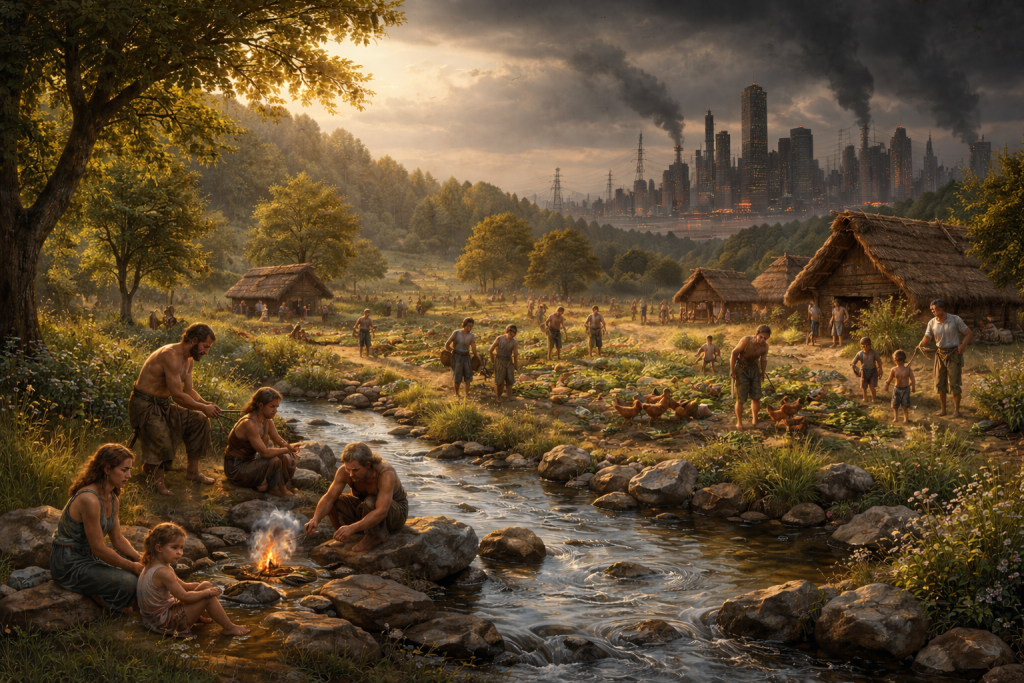
It is not hard to see the appeal. When you start listing what those conditions were, something in the body tends to agree. Regular contact with the natural world. Life organized around seasons rather than calendars. Direct connection to food, water, shelter, and the labor required to sustain them. Small, interdependent groups where roles were known, where belonging was less abstract. Rituals that marked transitions and losses, that gave form to grief and celebration. Ongoing proximity to other species. A sense that one’s life was embedded in something shared rather than privately constructed.
Placed alongside that, the current landscape can feel disorienting. Work that is detached from tangible outcomes. Communities that are diffuse or optional. Social contact filtered through screens. Constant exposure to information without clear relevance to immediate survival. The layering of capitalism, industrialization, globalization, and now digital life, each adding another level of remove from the conditions we were shaped within.
It begins to make intuitive sense that something in us would struggle here.
What I notice, though, is how quickly that understanding turns into something more definitive. It doesn’t just explain the present. It begins to reshape the past.
From there, the move is subtle but quick. If we are suffering because we have moved too far from what we are built for, then it starts to follow that those earlier conditions must have been more aligned, more coherent, maybe even better in some essential way.
I notice how easily I can be pulled into that conclusion, especially when it is spoken with confidence. Someone names the mismatch clearly, links it to rising anxiety or depression, points to capitalism or technology as the turning point, and for a moment it feels like the pieces lock into place. My own thinking can start to reorganize around it. Not exactly because I’ve tested it, but because it lands with a kind of authority that feels easier to borrow than to question.
Later, I find myself sorting through what I actually believe. There is a particular kind of discomfort in realizing how quickly I can adopt someone else’s framing when it is delivered cleanly. It leaves me feeling less anchored than I would like to be, and more aware of how much my sense of clarity can depend on who I’m listening to in the moment.
Still, the underlying idea does not go away. There is truth in it. It is hard to argue that human nervous systems are unaffected by the scale and speed of modern life, or by the loss of embeddedness in land, community, and shared rhythms. It is hard to ignore the absence of structures that once held grief, conflict, and transition in more collective ways.
But this is where something shifts, and where I have started to slow down.
It can easily be folded into the broader story about modern life being the problem, which may be partly true, but also risks simplifying what is harder to feel directly. Because once that layer is in play, the pull toward the past takes on a slightly different tone. It is not just about explanation anymore. It is also about relief. The image of earlier ways of living begins to carry some of that unnamed weight, giving it shape, even if the shape is not entirely accurate.
There is something about that move that is stabilizing. It locates what feels diffuse. It suggests that what is off in the present has a clearer origin and, by implication, a clearer direction.
But those earlier conditions did not exist outside of hardship or burden. The same tight-knit communities that offered belonging also enforced conformity in ways that could be punishing or violent. Roles were known, but they were often rigid, with little room to move outside of them. Gender, caste, and social hierarchies were not abstract problems; they were lived constraints with real consequences.
Connection to land meant dependence on it in ways that could turn quickly. Crop failure, drought, and harsh winters were not inconveniences but threats to survival. Proximity to other species included disease, injury, and vulnerability without the buffer of modern medicine. Infant mortality was high. Life expectancy was shorter. Pain, loss, and unpredictability were woven into daily life without the kinds of interventions we now take for granted.
Even rituals, which can be idealized as sources of cohesion and meaning, were often embedded within systems of belief that also carried fear, exclusion, or control. They held communities together, but not always gently.
Holding both of these at once changes the picture. There are real losses in how we live now, and they register in ways that are not always conscious or named. At the same time, the past we reach for when trying to make sense of those losses is often carrying more than we let in. It becomes easier to feel the pull than to hold the full complexity.
I find that this is where the tension sharpens. The recognition of loss does not go away. The sense that something essential has thinned out still lands. But the idea that it existed in a more complete form before becomes harder to stand on without qualification.
And without that footing, there is less to organize around.
What remains is less resolved than I might prefer. There are aspects of earlier ways of living that point to needs we still carry: for connection, for rhythm, for participation in something beyond ourselves. There is also no version of those conditions that existed without constraint, suffering, and forms of burden that we would not choose now.
So the pull toward a golden past starts to feel less like an answer and more like something to pay attention to. Not something to dismiss, but not something to follow too quickly either. It gathers something real. It just does not represent it cleanly.
For feedback and comments, I can be reached at max@maxlittman.com.
I provide consultation and therapy for therapists.
Purchase my new book IFS Therapy for Gay and Queer Men here.