
Max Littman, LCSW
April 12, 2026
There are moments in therapy when a client says something that feels important to them and nothing inside me moves toward it.
I am listening. I care about them. I want to understand. But internally, there is no echo. No recognition. No sense of familiarity. What happens next is subtle. A part of me leans forward, trying to find the connection. Another part starts scanning: Did I miss something? There can be a flicker of self-consciousness, a concern that the lack of response might be visible.
My face stays engaged. My posture holds. At times I imagine I might look thoughtful. At other times, perhaps slightly frozen, like I am buying time. Underneath that, something more familiar begins to organize. A critical voice: You should be getting this. Another: What kind of therapist doesn’t resonate with their client? Alongside that, a soft numbing, a slight pull away from the moment, even as I am still trying to be present.
We do not often talk about this aspect of therapeutic work. There is an assumption, sometimes implicit, that attunement includes resonance. That if we are grounded, open, and present, something inside us will recognize what is being shared.
But internal systems do not work that way.
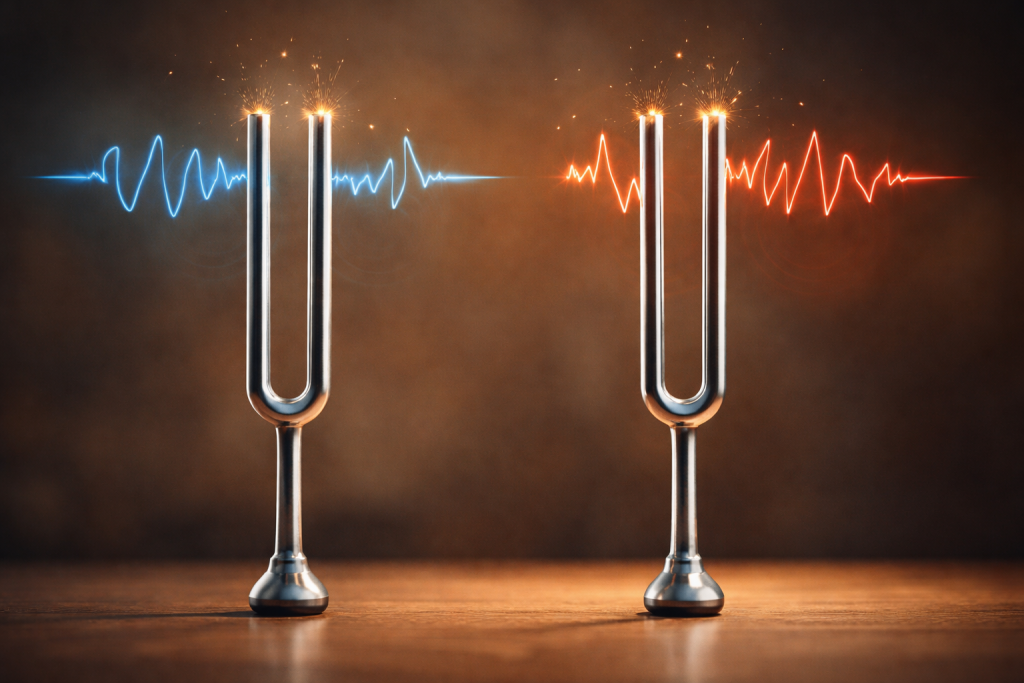
Resonance is selective. It depends on what lives inside the system. If a client speaks from a place that does not map onto anything in me, there may be no internal recognition to draw from. That does not mean I am not listening. It does not mean I am closed. It does not mean I am incapable of caring or understanding. It means our internal worlds do not overlap in that particular place.
This becomes more complicated in group settings, especially professional ones.
In a therapy training, consultation group, or clinical discussion, ideas are often shared with an expectation that others will recognize their importance. When resonance is present, the group tends to organize around it quickly. Heads nod. Energy gathers. A sense of shared understanding develops.
When resonance is absent, the experience is different. Something may be said that does not land in the same way across the group. In the absence of a strong relational container, parts may move quickly to restore coherence. Some people may disengage quietly. Others may agree outwardly without feeling it. Still others may become internally activated.
There are also moments of counter-resonance. Something does not just fail to land, it activates or unsettles. A comment may feel off, misattuned, or even subtly shaming. In a setting where there is not enough safety to name that impact, parts often manage it internally. A person may remain outwardly composed while protectors organize around irritation, withdrawal, or self-doubt.
The group continues, but the internal experience fragments.
Social pressure plays a significant role here. In many professional and intellectual spaces, resonance is treated as a sign of depth or alignment. When others seem moved by something and we are not, parts can feel exposed. There can be an urge to agree, to nod, to signal understanding that is not fully there.
At that point, something shifts. What looks like resonance from the outside is no longer resonance. It is performance.
Over time, this can become a quiet habit. We learn how to mirror language, tone, and emotional cues in a way that maintains connection. It works. It also creates a subtle distance from our own experience. That distance can show up as self-criticism, as doubt about our own perception, or as a kind of internal flattening where our responses become harder to locate.
Overvaluing resonance has costs in both directions.
When we do not resonate, parts may turn inward: What’s wrong with me? Why don’t I get it? Other parts may move outward, dismissing what was said in order to restore a sense of certainty. Both reactions reduce the discomfort, but neither reflects what is actually happening.
When we try to force resonance, something else is lost. The connection becomes less grounded. We begin relating from an approximation rather than from where we actually are. Over time, this can narrow our internal range and our relational honesty.
Resonance also shapes where we orient.
If it becomes the primary way we determine what is meaningful, we may begin to gravitate toward people, ideas, and communities that echo what is already familiar. There is ease in that, and also a quiet contraction. Difference becomes harder to stay with. Engagement becomes conditional on recognition.
In this way, resonance can become a liability. Not because it is inherently problematic, but because of how easily it becomes over-relied upon. When it functions as the measure of what is true, meaningful, or worth engaging, our world narrows without us noticing.
In therapy, the implications are specific.
A client may share something that matters deeply to them, and my system may not resonate with it. If I treat that as a problem, parts of me will start working to correct it. I may search for the “right” way to connect or subtly shape my responses to create alignment. The client may sense something slightly off, even if they cannot name it, not because I failed to resonate, but because I moved away from what was actually happening inside me.
The alternative is less polished. It involves remaining present without an internal echo, allowing curiosity to stay active even when recognition is not there, and letting my attention rest on what is being shared without needing to feel it in the same way.
This does not produce the same sense of mutual recognition. It allows for contact without requiring similarity.
That distinction can be difficult for parts that learned early that being understood depended on being mirrored. When resonance is absent, those parts may feel the old absence again. But adult connection can hold something different. Two people can remain in relationship even when their internal worlds do not align in certain places. Care does not require sameness.
There is another shift that can be disorienting in a different way. Something that once resonated deeply no longer does. An idea that once felt clarifying now feels flat. A framework that once organized experience begins to feel repetitive. A voice that once felt compelling lands differently.
Parts often rush to interpret this change through disappointment, criticism, or self-doubt. But resonance is not fixed. Internal systems change. What is alive in one period of life may no longer be central in another. The absence of resonance does not invalidate what was once meaningful. It reflects a shift in what is currently active inside.
Over time, a quieter capacity becomes more available. It is the ability to notice when something resonates and when it does not, without rushing to resolve either state. It allows connection to exist without requiring an internal echo, and it creates space for difference without immediate judgment or withdrawal.
Sometimes the most accurate internal observation is simple. Nothing inside me is moving toward that. Sometimes the most honest response is to let that be true without turning it into a judgment about ourselves or the other person.
And in certain moments, especially in groups where safety is still forming, that honesty may remain internal. Even then, recognizing it can help prevent the more costly alternatives of forced agreement, quiet disengagement, or self-directed criticism.
Not everything is meant to land inside every system. Not everything needs to.
And connection, at times, depends less on resonance than on the willingness to remain present in its absence.
For feedback and comments, I can be reached at max@maxlittman.com.
I provide consultation and therapy for therapists.
Purchase my new book IFS Therapy for Gay and Queer Men here.